
Containd exists because of an amount, not an event. Ten years in one apartment, with a storage compartment attached to it, and no way to answer a simple question: what do I actually have in here?
Two things made me ask it properly. I wanted to know what my stuff actually amounted to, and then I started preparing to move, which answered the question whether I wanted it or not. It was a lot, and it was scattered across the apartment and the storage room.
There is a smaller story I used to tell at this point. I once bought the same item three times, and I did not notice the second time even while I was putting it into my inventory. That story is related, and it is an anecdote. It is not the reason the app exists.
The reason is that I could not look up what I owned. Not where I had put it: whether I had it at all. And I could not look it up because there was nothing to look it up in.
The move is what made the problem visible
I had lived in that apartment for ten years. Carrying things in and only carrying packaging out. Nobody plans that, and it is not a character flaw, it is what happens when moving is expensive and throwing away is a decision you can postpone.
The question stayed theoretical until I had to pack. Packing forces an inventory, because you cannot put an unknown quantity into a known number of boxes. That is when the scattered part became obvious: the same category of thing living in four rooms, and no single place that knew it.
The urge to search your own apartment is not new
What is new is that we all got trained to expect it. Search the web for anything else and you get an answer in a second. Then you stand in your own hallway trying to remember which closet the spare charger went into, and the mismatch starts to feel absurd.
I kept doing something I am slightly embarrassed to write down. I would think about googling where I put something, and then remember that Google indexes pages other people wrote, not the shelf behind my coats. Nobody has ever written a page about the inside of my storage room.
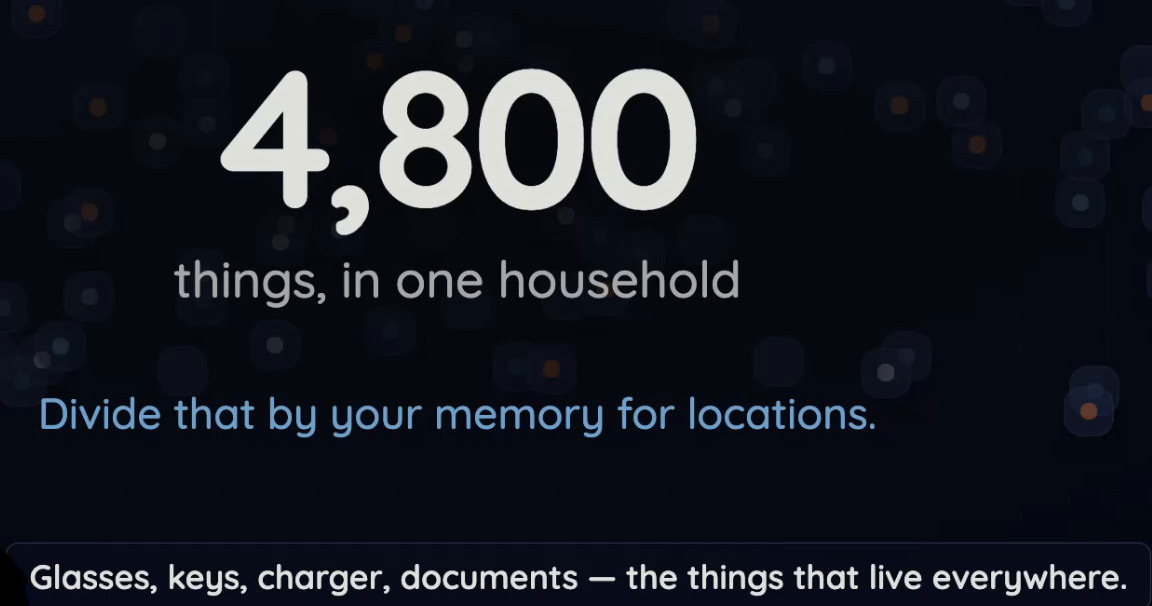
Four thousand eight hundred things in one household. It is a number from my own apartment, not a survey, and it is the sort of figure that sounds wrong until you start counting the contents of one kitchen drawer.
Divide that by how many locations you can reliably recall and the arithmetic is unkind. Most of those things you do not need this week. The problem is the small subset you do need and cannot place.
Ten years is longer than it sounds

"I have too much stuff" is a genre of online content that mostly sells shame, so let me be clear. I am not a hoarder. I kept an apartment for a decade, which is ordinary and produces an unordinary amount of things. And I like my things. If the apartment burned down I would not rebuy most of it, but that is a thought experiment about a disaster, not a plan for a Tuesday.
What made the problem solvable was not a change in my habits. It was that naming things got cheap. Photograph a shelf, let a model read it, and the boring part stops being the bottleneck. That is the part of this that only became possible recently, and it is not perfect.
The idea, in one sentence
Put everything you own on a map, so you can look it up the way you look up anything else. A floor plan, containers inside rooms, things inside containers, and a search box on top.

The nesting is not decoration. It matches how storage already works: an apartment has rooms, rooms have closets, closets have boxes, boxes have things. Entering that structure once means a later search can say "hall closet, top shelf, the small box" instead of "somewhere in the apartment".
I should be careful here, because "put it on a list" is the obvious advice and it is also the advice that quietly fails. A list you have to remember to check would not have stopped me buying something I had forgotten about. I did not go looking, which is the whole problem.
A map changes that because you run into the answer. Adding the second one to my inventory is the moment I should have noticed it was already there, and on a map I would have been looking at the first one. That is the difference between a list you consult and a map you see.
And a map is only useful if you can look at it when the question arrives, which is usually not a convenient moment. So the app needs no account, no subscription and no connection to answer it. Everything I am describing works offline, because a lookup you cannot do in a cellar is a lookup you will not do.
Keeping the map is the real problem
Making the map is work, and keeping it current is more work. Stuff moves, nothing tells the map, and a record that is confidently wrong costs you a trip to the wrong closet.
So the thing I actually want to build is not the capture. Capture already has an answer that mostly works: one photo per item, or one photo of a whole shelf cut into items, with AI filling in names you would never have typed. It was fast enough that I used it while packing, which is the only test that matters.
The upkeep is the part worth solving. What I want is a loop with no remembering in it: you move the thing, the app notices, the AI proposes the change, you tap once, and the map is current again.
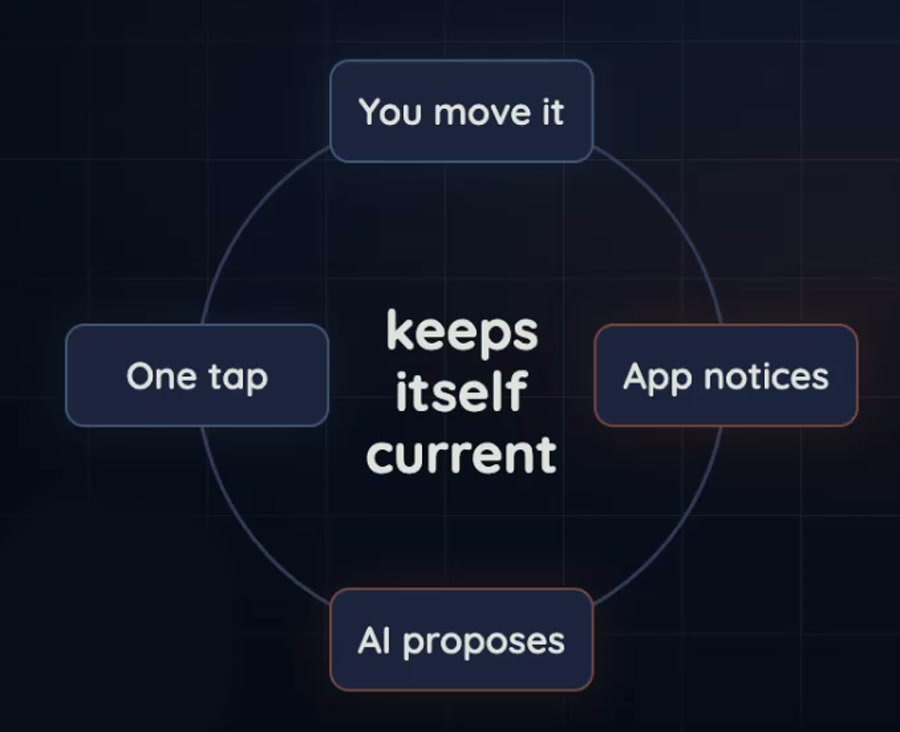
Part of that loop exists today. You tell the assistant you moved something and it works out what you meant. It still needs you to say it, which is fine for storage you rarely touch and not fine for the things you move every week.
The middle is what I have not solved: things you move often enough to matter and not often enough to remember to log. I have ideas about hardware that tracks a position and updates the record on its own. Those are ideas, not features, and I will not pretend they ship next month.
One thing I decided early
If the app knows where everything in my apartment is, it knows something fairly intimate about how I live, and that is worth more to some companies than the app is worth to me. So the free app is local first: no account, no subscription, no signal needed. Cloud sync and a cloud AI backend exist if you want them, but they are options rather than the price of entry, and I do not sell the data. You can also point your own agent at it, in which case the model is yours and my servers are not involved.
See what it became
Containd is free on iOS, Android and the web. The map is the point; this log is where it came from.
What happens next
The honest answer is that this depends on whether anyone wants it. I am not being coy. A free app that nobody uses produces no revenue and no reviews, which is at least a quiet failure rather than a loud one.
So the next entries are about the parts that are still open: capture that needs less of your attention, maintenance that survives a normal week, and the business model that pays for the servers without turning your inventory into a product. I will write those as they happen, with the parts that go wrong left in.