I started publishing videos this autumn, and the first three cost me an evening each. Not the recording. The recording was forty minutes of talking and pressing stop. Everything after it was the evening: finding the pauses, cutting them, naming the clips, picking music, fighting a timeline, then writing a page about a video I had already explained once.
So I built the pipeline I use now, out of open source parts and my own hardware. It is a do-it-yourself setup, and I mean that as a description rather than a boast: the pieces are free, they are ordinary, and the work is in wiring them together. Half of it exists because a step annoyed me enough, and the other half exists because a step turned out to be easier to review than to perform.
Two machines and one folder
The whole thing hangs on a shared folder. OBS writes the raw recording onto the NAS, an always-on box that both machines can see. That single decision does more work than any agent in the chain, because the handoff between steps stops being a message and becomes a file path. Nothing has to be running at the same time as anything else.
The agent on the other server picks the file up, transcribes it locally with Whisper, and marks the dead air. Whisper runs on my own hardware, which means no minute counter and no upload. The transcript is the first thing I get to look at, and it is also the thing that makes every later step possible.
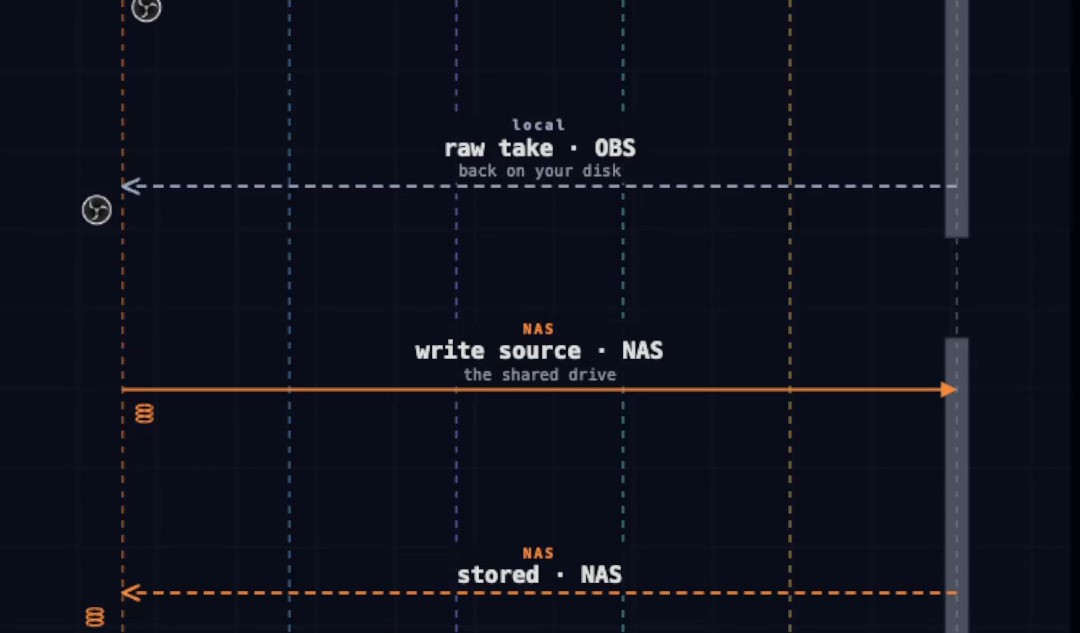
Then it hands the whole thing to me as a review, and stops.
The review is the only step that is not automated
Every job ends in a portal on the LAN, and the portal is where the decisions are. A cut gets proposed because the model heard a pause, a clip gets proposed because a sentence stands alone, and both wait for a yes. The recording for this entry came in at 791 words across 13 segments, and the portal showed me every one of them with the filler already struck out.

Click a word and the player jumps there. Right-click and it is cut or kept. Double-click and you fix a misheard word in place. The same pass proposes portrait clips, because a sentence that stands on its own is usually a short, and a machine that has just read the transcript is well placed to notice one.
When the list is right, I approve it, and the approval is a file, not a phone call. The next agent reads it and continues without me repeating anything.
The review is also where the pipeline pays for itself. Reading a transcript and striking four pauses is a ten-minute job I can do badly at the end of a day. Scrubbing a timeline for the same four pauses is an hour I cannot.
A music agent proposes, and I still pick
The editor agent asks a second agent for music, and that agent writes candidate themes rather than searching a library. Each one arrives with its key, its tempo, its length and a written verdict on how it reads next to speech. Three candidates for this job, none of them mixed into the picture, so what I am judging is the music and not the mix.

I picked the plainest one. That is the whole argument for writing three: a library gives me things other people chose for other videos, and the interesting decision here was between three shades of unremarkable.
I do the composition, on purpose
The edit is assembled in FilmCraft, an editor that takes instructions over a protocol agents can speak (MCP, if you have met it), so an agent can build a real project file with the clips on the timeline and the music underneath. It is not a rendered output with no way back in. I open that project and finish it myself.
That is the line I drew, and I drew it after watching an agent get a cut ninety percent right. Ninety percent of an edit is a video that is slightly wrong in a way nobody can name, and the last ten percent is where the timing lives. Handing that over would have saved me twenty minutes and cost me the reason to publish.
Then it writes the page
The finished cut goes back to the NAS, and a third agent takes it from there. It proposes a thumbnail, tells me which face and which screenshot it wants and why, waits for a plan to be approved, then draws the title card as a vector file, which stays editable. I open that file and adjust the type, because I have opinions about type. It compiles what I hand back.
After that it writes the posts for the platforms and files them in Mixpost as drafts. It does not schedule them, and it does not check whether anything went out. A draft in Mixpost stays a draft: the timing, the decision that something is worth saying today, those are mine, which is the part I would not hand over anyway.
And it writes this. The same recording becomes an article page with a transcript-derived argument, figures cut from the video, and a pull request against the site repository that I merge myself. Writing the page from the transcript is faster than writing it from memory, and it is more honest, because the transcript does not let me skip the part I said badly.

What it costs and what it does not fix
Almost all of it runs on my own hardware, and the software is free or close to it. The transcript, the dead air, the music, the edit and the page all happen locally. What I pay for is a capable model to orchestrate the agents, and that is the one part of the chain I cannot replace with a script, because routing a job between agents is judgement rather than a fixed sequence.
The limits are worth writing down. The music agent cannot hear its own work, so every verdict it gives is measured rather than listened to, and I check it by ear. The thumbnail plan is a proposal I have rejected more than once. The pipeline does not know whether a video is good, and the channel is four weeks old with most shorts sitting at no views, which is the number that tells me nothing has been proven yet.

What the pipeline did fix is that publishing stopped being an evening. A recording now goes from a file on a NAS to a reviewed video, a set of posts and a page, and the parts that need taste still have me in them. The parts that needed patience do not.
See what it became
Containd is free on iOS, Android and the web. The map is the point; this log is where it came from.